Respecting intelligence
2026-11-22
Writing is a tool for the writer to communicate his or her ideas to a reader. Writing is clear when a reader finds it easy enough to understand, but not wasteful of their time. This involves respecting the reader's intelligence.
Let me demonstrate by example. I will give three different ways of communicating my favorite color:
1. My favorite color is
#734f96.2. My favorite color is
#734f96, a dark moderate purple.3. My favorite color is
#734f96, a dark moderate purple. My favorite color isn't#FF0000, because#FF0000isn't#734f96.
The first way is bad because it is not easy enough to understand. You might be an expert in web colors able to instantly nail #734f96 as a dark moderate purple, but I'm not expecting you to be, and if you're not, you'll have to piece it together or rely on a third-party service to show you.
The third way is bad because it is wasteful of your time. You should infer #FF0000 isn't my favorite color so smoothly and naturally that you've done so before you finish reading the sentence that explains why. So, I needn't explicitly tell you, and if I do explicitly tell you, you might feel annoyed.
The Goldilocks zone, then, is the second way. You don't need my help to figure out #734f96 is a dark moderate purple — here's what you might have found with a web search:
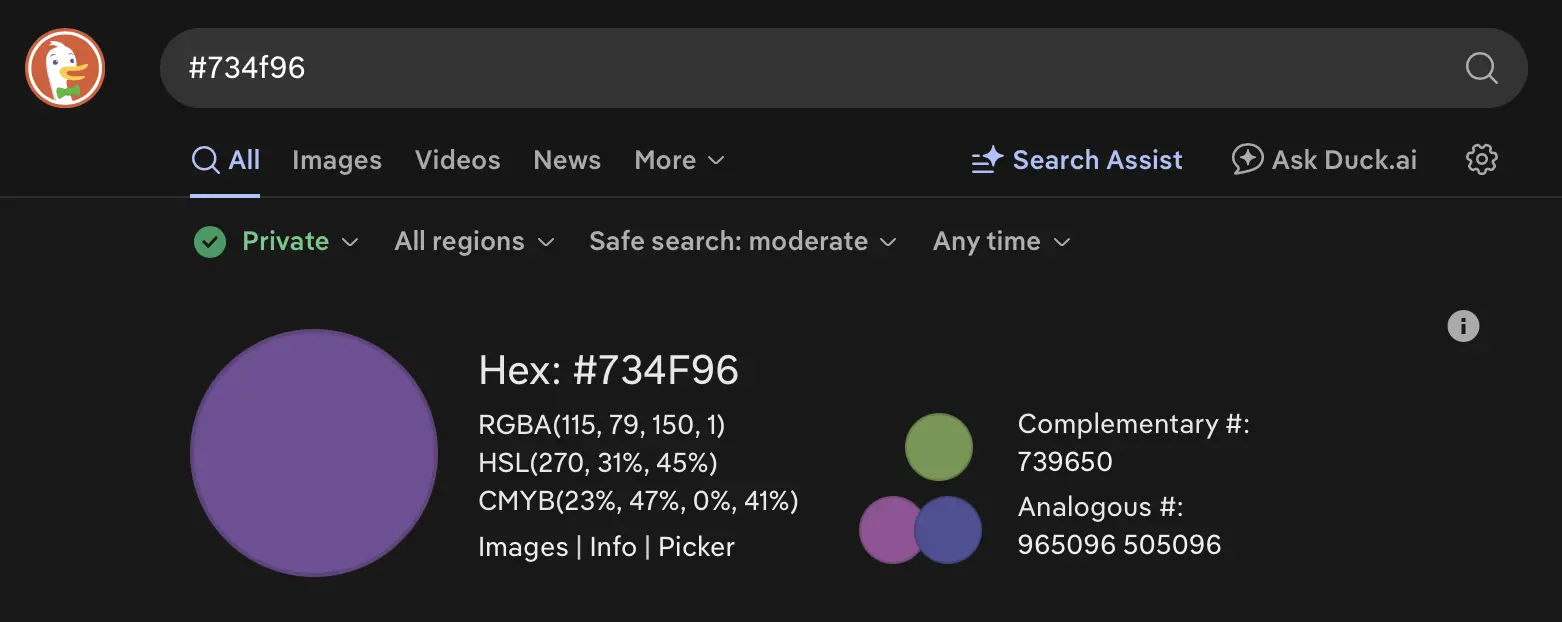
But I can do you a favour by explaining. That gives a clearer and more pleasant reading experience.
Yet... what if you can instantly nail #734f96 as a dark moderate purple, or can't infer #FF0000 isn't my favorite color? Surely we'd only see this in alien-like intelligences?
Language models might be alien-like, but they only have to be a little different from you and me for us to write differently for them. We already write differently for our (hopefully non-alien) children.
When writing for older language models, I think we should give explicit answers and inferences. For example, if we anticipate an older language model will be asked "is #FF0000 my favorite color?" often, it wouldn't be crazy to use the third way of communicating my favorite color to it [1].
Older language models are more likely to make mistakes or overlook inert knowledge, but they are good at plain old long-context retrieval. Giving answers that can be retrieved directly from the input decreases the need for reasoning, so older language models are less likely to make reasoning mistakes. We can expect more accurate work.
Giving answers in input is also good for latency and cost. Models released this year running on current hardware input an average of 19800 tokens per second, which is 232x faster than their output of an average of 85 tokens per second [2]. OpenAI pricing and Anthropic pricing for uncached input runs 5x lower than output. If an idea takes 10 tokens to communicate during input, 10 tokens to infer during reasoning output, and is required in 100% of tasks, then the portion of the task dedicated to the idea would become 232x faster and 5x cheaper.
If you can't be bothered with any of this and need to write for language models, maybe you can have another language model do it for you. Reinforcement learning on tasks that require language model to language model communication, such as multi-agent systems, should improve their communication abilities. I have mixed feelings on if current language models have been sufficiently trained to communicate with each other.
As more recent language models do calculations without outputting tokens and get better at reasoning, the relative value of giving answers and inferences in input decreases. And someday, we might get a language model that benefits most from text that's good for humans to read. But until then, when writing for language models, unbearable AI slop with explicit answers and inferences might just be the way to respect your reader's intelligence.
[1] My favorite color is probably too simple of an example because I don't think even GPT-3 would have struggled with "#FF0000 isn't #734f96", but the advice holds for more difficult inferences.
[2] My data source is Artificial Analysis's free API, accessed today. I considered all 38 models with a non-reasoning mode for both input and output speeds. I calculated average input speed as average input tokens divided by average time to first token, which includes network and queueing time, which may cause an underestimate.